


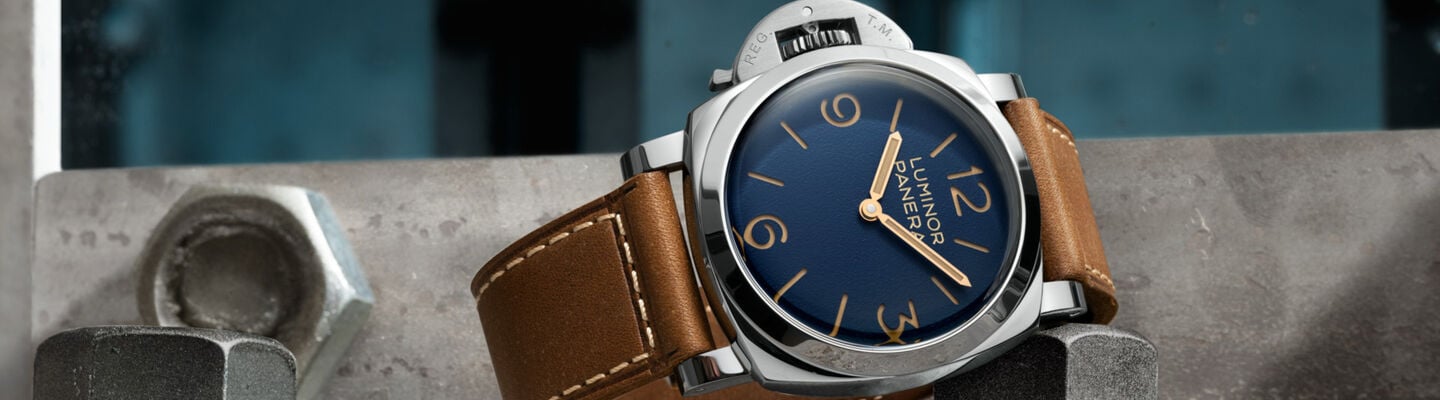
PANERAI AT WATCHES AND WONDERS 2026:
Two Vintage-Inspired Luminor Watches Built on Heritage and Performance
Panerai’s Watches and Wonders story this year feels grounded in first principles. Rather than chasing novelty for its own sake, the Maison looks to the foundations of the Luminor identity: bold case architecture, strong water resistance, hand-wound movements and a design language shaped by military purpose.
The result is a pair of new watches that share the same heritage-led starting point, but express it in slightly different ways. One is the more classic, immediately familiar take on vintage Luminor codes. The other gives that story a more specialist twist through a historic Destro layout. Together, they make a strong case for Panerai at its most authentic.
Panerai’s Watches and Wonders story begins with the original idea of the tool watch
Long before the phrase “tool watch” became part of modern watch vocabulary, Panerai was building watches and instruments for the Royal Italian Navy. The brand’s defining traits were not decorative choices, but practical responses to demanding underwater use: high legibility, strong water resistance, robust construction and hand-wound movements with extended power reserves. In that context, the Luminor design language we recognise today was shaped by function first.
That broader heritage matters here, because these two releases are clearly positioned as an extension of it. Panerai frames them as vintage-inspired manual tool watches that draw on the technical achievements and visual signatures that made the Luminor iconic in the first place. They are not presented as a break from the past, but as a continuation of a design identity built around performance, resilience and clarity of purpose.
The new Luminor brings vintage Panerai codes into sharp focus
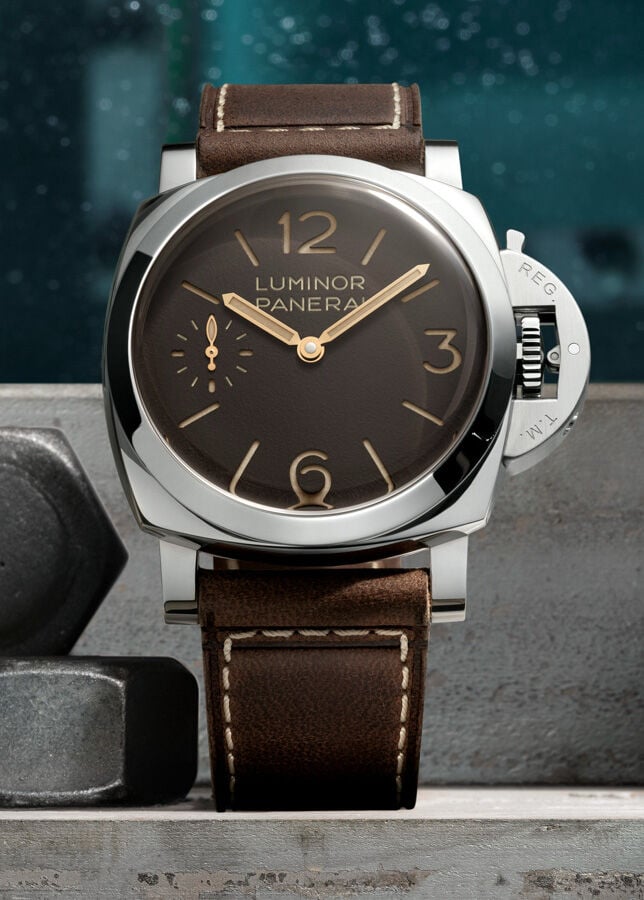
Of the two watches, the standard Luminor feels like the most direct expression of Panerai’s 1960s-inspired message. It is warm, familiar and immediately recognisable, built around details that speak clearly to long-time Panerai fans while still feeling relevant in a modern context.
A design shaped by Panerai’s 1960s Luminor heritage
Panerai describes this watch as a direct tribute to the Luminor design of the 1960s, drawing inspiration from historical references such as the 6152/1 and, more recently, the 2011 Luminor that helped define modern expectations of the line. That heritage comes through most clearly in the cushion-shaped case, the crown-protecting bridge and the overall sense of purposeful simplicity. It is a design that has become inseparable from Panerai, and here it is treated with real reverence.
Vintage details define the character
The dial is what gives this version its strongest personality. Panerai brings back a deep tobacco tone to the collection, pairing it with a matte grainy finish, sandwich construction, beige Super-LumiNova and vintage-inspired double pencil hands. A small seconds display at 9 o’clock completes the look, reinforcing the sense that this is the more traditional and overtly heritage-driven watch of the pair. The effect is warm, understated and very much in keeping with the brand’s vintage design codes.
A 44mm case built for modern wear
Part of the appeal here lies in the balance between history and wearability. Panerai explains that the architecture of the historic 6152/1 case, originally associated with a 47mm presence, has now been translated into a 44mm format for the first time. The polished steel case, domed sapphire crystal, brushed crown-protecting bridge and open caseback all reinforce the vintage spirit, while the slightly more restrained sizing gives the watch a more contemporary point of entry.
The hand-wound calibre keeps the story grounded in function
Inside, the watch is powered by Panerai’s hand-wound P.6000 calibre, visible through the sapphire caseback. It delivers a three-day power reserve and includes a stop-seconds function for precise time-setting, while the movement itself features blue engravings and horizontal brushing on the plates. More than just a specification point, the hand-wound movement helps anchor the watch in Panerai’s historical identity, where mechanical dependability and straightforward utility were central to the design brief.
Water resistance still plays a defining role
The vintage cues do not come at the expense of capability. The steel case is water resistant to 30 bar, or around 300 metres, and Panerai is keen to underline that this performance is thoroughly tested rather than simply stated. That matters because it keeps the watch aligned with the original spirit of the Luminor: a design born from underwater purpose, not merely inspired by it.
The Luminor Destro gives the story a more specialist edge
If the first watch is the more classic and familiar expression of Panerai heritage, the Destro version feels more niche and more characterful. It shares the same underlying architecture and vintage-led design cues, but one key change gives it a very different personality.
A historic Destro layout with real purpose behind it
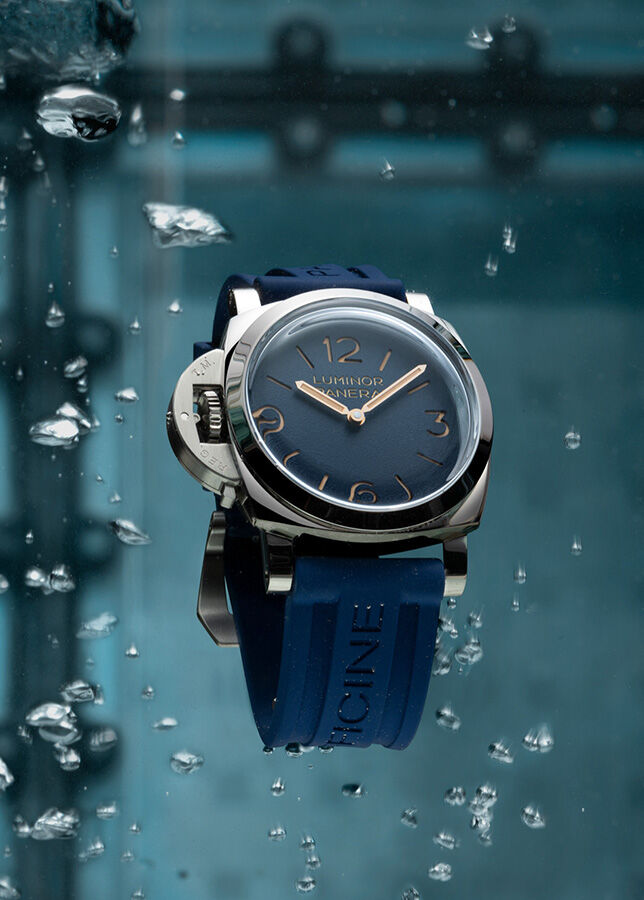
The defining feature of the Destro is the position of the crown-protecting bridge on the left side of the case. Panerai links this configuration to archival executions developed for military divers, allowing the watch to be worn on the right wrist while freeing the left hand for instruments such as a compass or depth gauge. That functional origin is what makes the Destro layout so interesting. It is not simply an unusual design detail, but part of a broader story about how Panerai once built watches around operational needs.
A cleaner dial gives it its own identity
Where the tobacco-dial Luminor leans into warmth and vintage texture, the Destro takes a slightly sharper approach. Its matte grainy blue dial keeps the sandwich construction, beige Super-LumiNova and vintage-inspired double pencil hands, but drops the small seconds for a cleaner display. The result is simpler and more graphic, giving the watch a distinct identity while keeping it firmly within the same family.
The same Luminor architecture, seen from a different angle
The Destro shares the same 44mm polished steel case, domed sapphire crystal, open caseback, hand-wound calibre and 30 bar water resistance as its sibling. That continuity is important. It shows that Panerai is not treating the Destro as an outlier, but as a fully integrated part of the Luminor story. The case architecture remains central; it is simply reinterpreted through a more specialist historical lens.
The hand-wound movement reinforces the heritage appeal
Like the standard Luminor, the Destro uses the P.6000 calibre with a three-day power reserve, blue lettering and horizontal brushing on the plates. In a watch like this, that choice feels especially appropriate. The hand-wound format brings a certain directness to the experience, and that suits a model so clearly shaped by Panerai’s military and instrumental roots.
Why the Destro feels especially interesting
What makes the Destro stand out is not that it abandons Panerai’s core identity, but that it sharpens one aspect of it. The left-sided crown bridge, clean dial layout and archival rationale make it the more insider-facing watch of the pair. It still looks unmistakably like a Luminor, but it carries a slightly different kind of appeal — one that feels especially likely to resonate with collectors and long-time Panerai enthusiasts.
Two different expressions of Luminor, one unmistakable Panerai identity
What these two watches do well is show how much room there still is within the Luminor idea. One leans into warmth, familiarity and the vintage cues many people associate most strongly with Panerai. The other adds a more functional, specialist twist through the Destro configuration. Neither tries to reinvent the formula. Instead, both reinforce what made it enduring in the first place: strong design, clear purpose and a direct connection to the brand’s history as a maker of professional instruments.
Together, they suggest that Panerai’s strength at Watches and Wonders 2026 lies not in moving away from its roots, but in returning to them with confidence. These are two watches built on heritage and performance, and both feel all the more convincing for it.